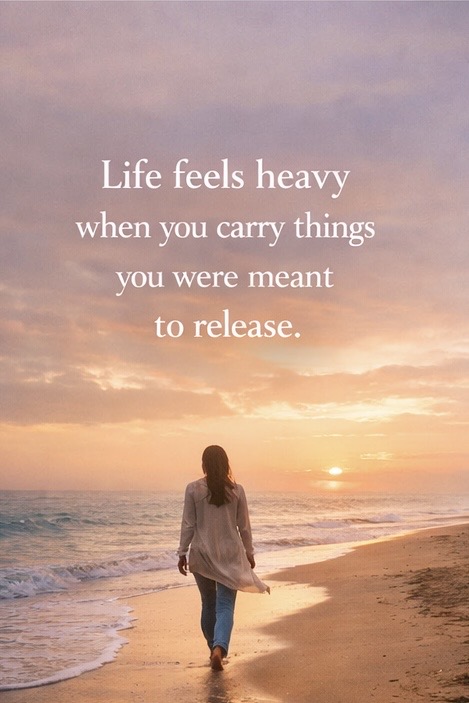
There are moments in life when everything feels heavier than it should.
Not just physically, but emotionally and mentally. Your thoughts feel crowded. Your energy feels low. Even simple things can start to feel overwhelming.
Often, the weight we feel isn’t coming from the present moment. It comes from the things we continue carrying long after they’ve served their purpose.
Old stories.
Past hurt.
Unrealistic expectations.
The pressure to control what was never ours to control.
Sometimes the greatest relief comes not from doing more, but from learning how to let go.
Why We Hold On
Letting go sounds simple in theory, but it can feel incredibly difficult in practice.
We hold onto things because they feel familiar. Even pain can feel safer than the uncertainty of release.
We hold onto:
• relationships that have already ended emotionally
• expectations about how life “should” look
• guilt from past mistakes
• the belief that we must carry everything alone
But holding on too tightly to the past can prevent us from fully experiencing the present.
What Letting Go Really Means
Letting go doesn’t mean pretending something never mattered.
It doesn’t mean forgetting what happened.
Instead, it means choosing peace over constant resistance.
It’s the moment when you realize that carrying the weight any longer is no longer helping you grow.
Letting go allows you to reclaim your energy, your clarity, and your emotional freedom.
Signs You May Be Carrying Too Much
Sometimes the weight we carry shows up quietly in our lives.
You might notice:
• constant mental replay of past events
• difficulty relaxing or feeling present
• emotional exhaustion
• resentment that never seems to fade
• a sense of heaviness you can’t quite explain
These signals are often your mind and body gently asking for release.
Gentle Ways to Practice Letting Go
1. Acknowledge What You’re Carrying
You can’t release what you refuse to see. Honest reflection is the first step.
2. Accept What You Cannot Control
Much of our stress comes from trying to control outcomes that were never ours to manage.
3. Allow Yourself to Feel
Emotions that are suppressed tend to stay stored in the body. Feeling them allows them to move through.
4. Create Small Rituals of Release
Journaling, meditation, breathwork, or simply taking a quiet walk can help create space for emotional reset.
5. Practice Compassion Toward Yourself
You’re human. Growth often comes through lessons, not perfection.
The Freedom That Comes After Release
When you begin to release what you no longer need to carry, something remarkable happens.
Your mind becomes quieter.
Your body feels lighter.
Your perspective shifts.
Instead of constantly looking backward, you begin to notice the possibilities in front of you.
Peace isn’t something you chase.
It’s something that naturally appears when you stop carrying what no longer belongs to you.
Closing Reflection
Life feels heavy when we carry things we were meant to release.
But every day offers a new opportunity to set something down.
Not all at once.
Not perfectly.
Just one small step at a time.
And sometimes, that small act of release is the beginning of a much lighter life